
Have you ever seen an online ad and clicked on it? That click is one way advertisers measure how well their ads work.
CTR stands for Click-Through Rate. It shows how often people click an ad or link after seeing it.
CTR is an important metric in online advertising and SEO. It helps you understand whether people are interested in what they see.
In this guide, you will learn what CTR means, how to calculate it, and how it compares with CPC and CPM. You will also see simple examples.
Table of Contents
- What Is CTR?
- What Does CTR Stand For?
- CTR Formula
- How to Calculate CTR
- CTR Examples
- What Is a Good CTR?
- CTR vs. CPC vs. CPM
- How to Improve CTR
- Frequently Asked Questions
- Final Thoughts
What Is CTR?
CTR means Click-Through Rate. It tells you what percentage of people who saw an ad or link clicked on it.
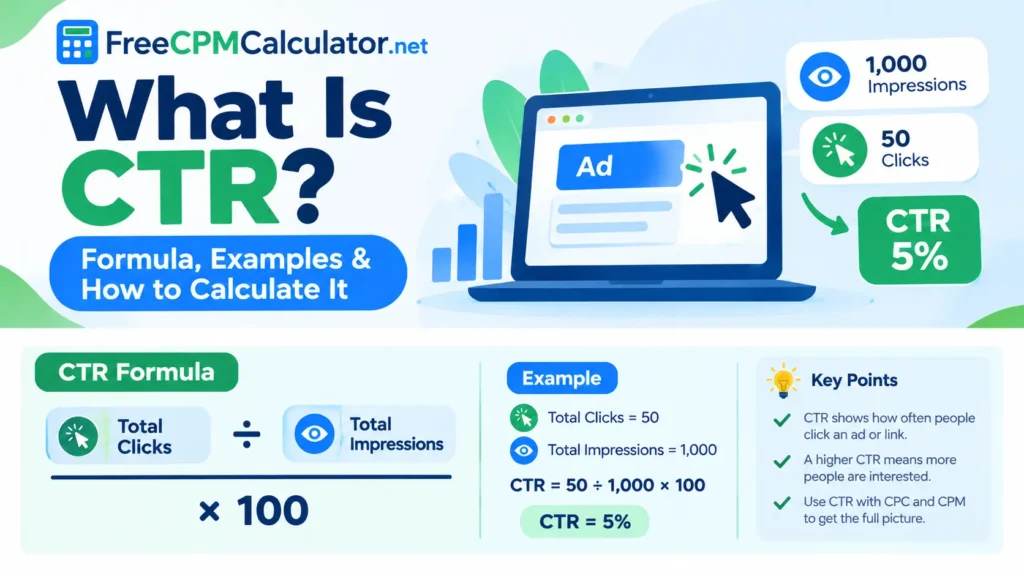
For example, imagine your ad appears 1,000 times and gets 50 clicks. Your CTR is 5%.
A higher CTR means more people clicked compared with the number of times your ad was shown. But a high CTR does not always mean more sales. You should also check whether those clicks bring useful visitors or customers.
What Does CTR Stand For?
CTR stands for Click-Through Rate.
People use CTR to measure clicks on different types of content, such as:
- Google Ads
- Social media ads
- Website links
- Email links
- Google search results
CTR can help you see which ads, links, or search results get more attention.
What Is the CTR Formula?
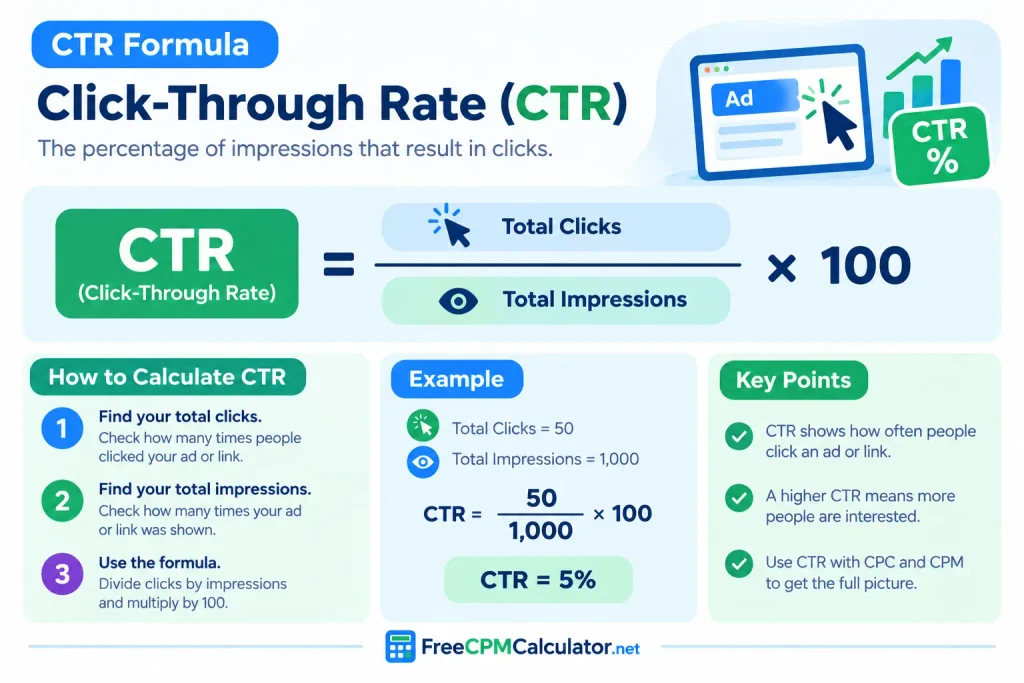
The CTR formula is simple:
CTR = (Total Clicks ÷ Total Impressions) × 100
Here is what the terms mean:
- Total Clicks: How many times people clicked.
- Total Impressions: How many times the ad or link was shown.
- CTR: The percentage of impressions that led to clicks.
Multiply the result by 100 to get the CTR as a percentage.
How to Calculate CTR
Follow these three easy steps.
Step 1: Find your total clicks.
Suppose people clicked your ad 40 times.
Step 2: Find your total impressions.
Suppose your ad was shown 1,000 times.
Step 3: Use the CTR formula.
CTR = (40 ÷ 1,000) × 100
Your CTR is 4%.
This means your ad received 40 clicks for every 1,000 impressions in this example.
Always use clicks and impressions from the same campaign and time period.
CTR Examples
Let’s look at three simple examples.
Example 1: A Small Ad Campaign
Your ad gets 20 clicks and 1,000 impressions.
CTR = (20 ÷ 1,000) × 100
CTR = 2%
Your ad has a 2% click-through rate.
Example 2: An Ad With More Clicks
Your ad gets 100 clicks and 2,000 impressions.
CTR = (100 ÷ 2,000) × 100
CTR = 5%
This means 5% of the ad impressions resulted in clicks.
Example 3: A Google Search Result
Your website appears in Google search results 4,000 times and gets 120 clicks.
CTR = (120 ÷ 4,000) × 100
CTR = 3%
You can check your website’s clicks, impressions, and CTR in Google Search Console.
These examples use made-up numbers to show how the formula works. Real results will depend on your website, audience, and advertising platform.
What Is a Good CTR?
There is no single CTR that is good for every website or ad.
A good CTR depends on where your ad or link appears and what you want people to do.
For example, CTR can be different for Google Ads, social media ads, email links, and organic search results.
When checking your CTR, think about these points:
- Your goal: Do you want website visits, sales, or leads?
- Your audience: Are you reaching the right people?
- Your content: Does your headline match what people want?
- Your results: Do visitors take the next step after clicking?
Compare similar campaigns and track your own results over time. Do not judge success by CTR alone.
CTR vs. CPC vs. CPM
CTR, CPC, and CPM are three common advertising metrics. Each one tells you something different.
| Metric | Full Form | What It Measures | Formula |
|---|---|---|---|
| CTR | Click-Through Rate | Percentage of impressions that get clicks | (Clicks ÷ Impressions) × 100 |
| CPC | Cost Per Click | Average cost of each click | Ad Cost ÷ Clicks |
| CPM | Cost Per Mille | Cost per 1,000 impressions | (Ad Cost ÷ Impressions) × 1,000 |
Here is an easy way to remember them:
- CTR: How often do people click?
- CPC: How much does each click cost?
- CPM: How much does it cost to get 1,000 impressions?
If you want to calculate advertising costs, try the FreeCPMCalculator.net CPM Calculator.
You can also read our guide, What Is CPC? Formula, Examples, and How to Calculate It, to learn more about cost per click.
How to Improve CTR
If your CTR is low, there are a few things you can try.
1. Write Clear Headlines
Use a headline that tells people what they will get. Avoid confusing or misleading headlines.
2. Match Your Content to What People Want
Your page or ad should answer the question people have. Useful and relevant content gives people a reason to click.
3. Improve Your Ads
Try different headlines, images, and ad text. Compare the results to see which version works better.
4. Use a Clear Call to Action
Tell people what they can do next. For example, you might invite them to learn more, read a guide, or use a calculator.
5. Check Google Search Console
If you have a website, open Google Search Console and check the Performance report.
Look at the pages and search terms that get impressions but few clicks. Make sure your page title clearly explains what the page offers.
6. Check What Happens After the Click
A high CTR is useful, but visitors should also find what they expected. Check whether people read your content, use your tool, or complete the action you want.
Frequently Asked Questions
What does CTR mean?
CTR stands for Click-Through Rate. It shows the percentage of impressions that result in clicks.
How do I calculate CTR?
Divide total clicks by total impressions, then multiply by 100.
For example, 50 clicks from 1,000 impressions gives you a CTR of 5%.
Is a high CTR always good?
No. A high CTR means more people clicked compared with the number of impressions. It does not guarantee sales or profit.
What is the difference between CTR and CPC?
CTR measures the percentage of impressions that get clicks. CPC measures the average cost of each click.
What is the difference between CTR and CPM?
CTR shows how often people click. CPM shows the cost of 1,000 impressions.
Where can I check my website’s CTR?
You can check your organic search CTR in Google Search Console. Open the Performance report under Search results to see clicks, impressions, CTR, and average position.
Can CTR be 0%?
Yes. If a link or ad gets impressions but no clicks, its CTR is 0%.
Final Thoughts
CTR helps you understand how often people click an ad, link, or search result after seeing it.
You can calculate CTR by dividing clicks by impressions and multiplying by 100.
Remember that CTR is only one part of online performance. You should also look at costs, sales, and other results that matter to your goals.
For help with advertising costs, visit FreeCPMCalculator.net and use the CPM Calculator to work out your cost per 1,000 impressions.