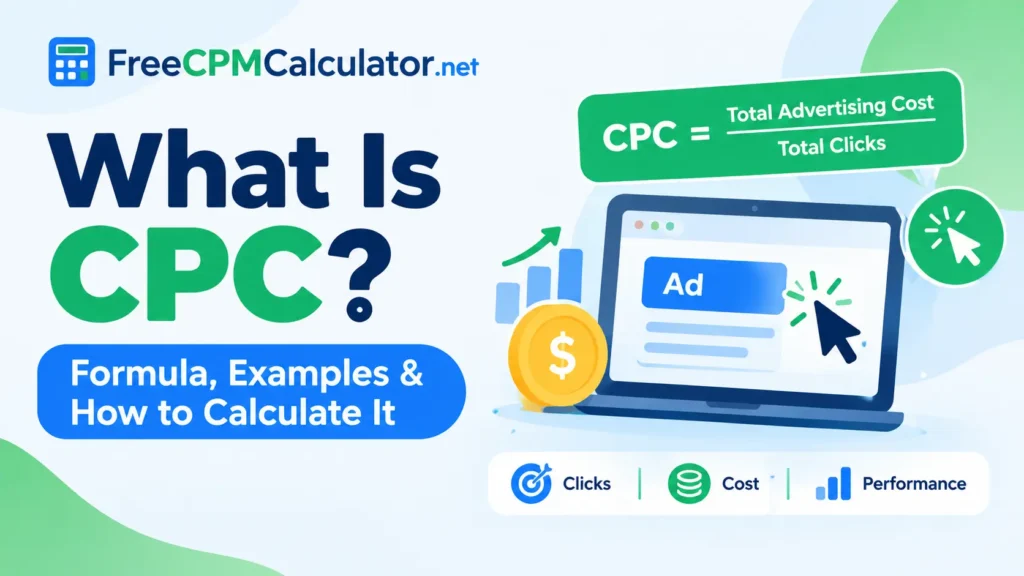
CPC is one of the most important metrics in digital advertising. It helps advertisers understand how much they pay when someone clicks on an ad.
Whether you advertise on Google, social media, or another online platform, understanding CPC can help you measure campaign costs and manage your advertising budget more effectively.
In this guide, you will learn what CPC means, how to calculate it, see practical examples, and understand how CPC differs from CPM.
Table of Contents
- What Is CPC?
- What Does CPC Stand For?
- CPC Formula
- How to Calculate CPC
- CPC Calculation Examples
- What Is a Good CPC?
- CPC vs. CPM
- CPC vs. CTR
- How to Improve Your CPC
- Frequently Asked Questions
- Final Thoughts
What Is CPC?
CPC stands for Cost Per Click. It is the amount an advertiser pays for each click on an advertisement.
For example, suppose you spend $50 on an advertising campaign and receive 100 clicks. Your average cost per click is $0.50.
CPC helps you understand how efficiently your advertising budget generates clicks. However, a low CPC does not automatically mean a campaign is successful. You should also consider the quality of the visitors, conversions, and revenue generated.
What Does CPC Stand For?
CPC means Cost Per Click. It is commonly used in online advertising campaigns where advertisers pay based on clicks.
You may encounter CPC when working with:
- Search engine advertising
- Social media advertising
- Display advertising campaigns
- Paid traffic campaigns
- Affiliate marketing
Depending on the advertising platform and campaign type, the actual charging method can vary. CPC is also commonly reported as an average metric.
What Is the CPC Formula?
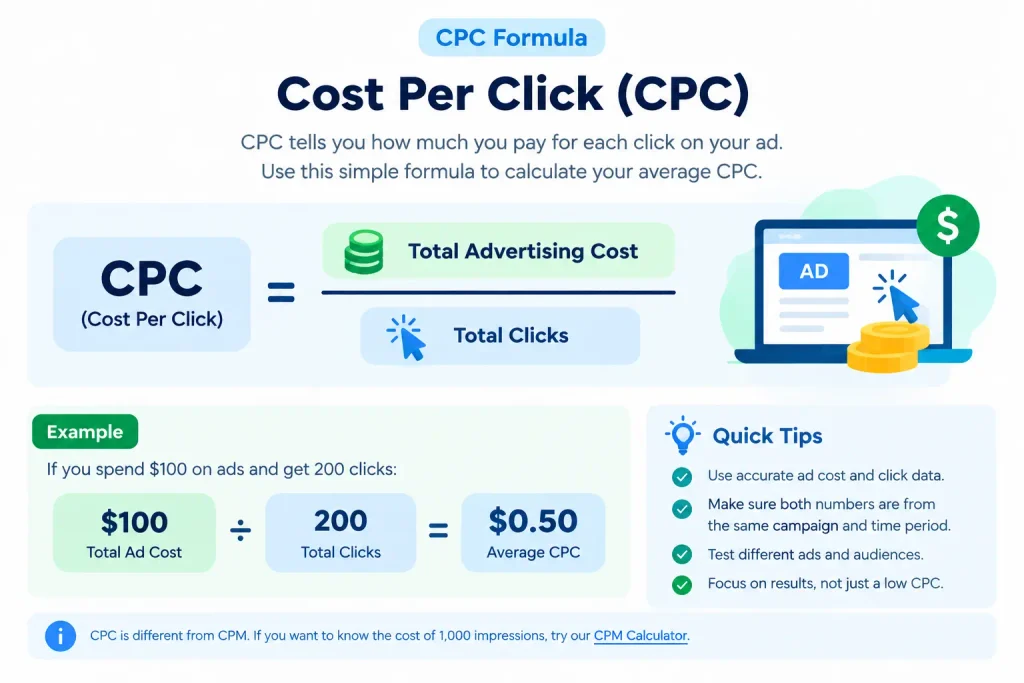
The CPC formula is:
CPC = Total Advertising Cost ÷ Total Clicks
To calculate average CPC, divide the total amount spent on advertising by the number of clicks received.
For example:
- Total advertising cost: $120
- Total clicks: 240
CPC = $120 ÷ 240
Average CPC = $0.50
This means each click cost an average of 50 cents.
How to Calculate CPC Step by Step
Follow these three simple steps:
Step 1: Find your total advertising cost.
Check how much you spent on the campaign during the period you want to measure.
Step 2: Find the total number of clicks.
Use the click data reported by your advertising platform for the same campaign and time period.
Step 3: Divide cost by clicks.
Divide your total advertising cost by your total clicks to find your average CPC.
Make sure your cost and click figures cover the same campaign and reporting period.
CPC Calculation Examples
Here are three simple examples to help you understand the calculation.
Example 1: Small Advertising Campaign
Suppose you spend $20 and receive 80 clicks.
CPC = $20 ÷ 80
CPC = $0.25
Your average cost per click is 25 cents.
Example 2: Medium Advertising Campaign
Suppose your campaign costs $150 and generates 300 clicks.
CPC = $150 ÷ 300
CPC = $0.50
Your average CPC is 50 cents.
Example 3: Higher Advertising Cost
Suppose you spend $500 and receive 400 clicks.
CPC = $500 ÷ 400
CPC = $1.25
Your average cost per click is $1.25.
These examples use hypothetical figures. Actual CPC depends on your platform, audience, competition, campaign settings, and other factors.
What Is a Good CPC?
There is no single CPC that is good for every advertising campaign.
A CPC of $1 may be affordable for a business that earns substantial revenue from each customer, but too expensive for a business with a small profit margin.
When evaluating your CPC, consider:
- Your campaign goal: Are you trying to generate traffic, leads, sales, or brand awareness?
- Conversion rate: How many clicks lead to a desired action?
- Profit margin: How much can you afford to spend to acquire a customer?
- Audience quality: Are the clicks coming from people likely to be interested in your offer?
- Industry and competition: Advertising costs vary across markets and keywords.
Instead of comparing CPC alone, evaluate the results your advertising spend produces.
CPC vs. CPM: What Is the Difference?
CPC and CPM measure different aspects of advertising costs.
CPC means Cost Per Click. CPM means Cost Per Mille, or cost per 1,000 ad impressions.
| Metric | What It Measures | Formula |
|---|---|---|
| CPC | Average cost per click | Ad cost ÷ clicks |
| CPM | Cost per 1,000 impressions | (Ad cost ÷ impressions) × 1,000 |
| CTR | Percentage of impressions that generate clicks | (Clicks ÷ impressions) × 100 |
CPC is useful when you want to understand the cost of generating clicks. CPM is useful when you want to measure the cost of displaying ads.
For example, if you want to estimate the cost of reaching an audience through impressions, use a CPM calculator.
You can use the FreeCPMCalculator.net CPM Calculator to calculate CPM from advertising cost and impressions, or estimate cost when the required inputs are available.
CPC vs. CTR
CPC and CTR are related, but they do not measure the same thing.
CPC tells you how much each click costs on average. CTR, or Click-Through Rate, tells you what percentage of impressions resulted in clicks.
For example, an ad receives 1,000 impressions and 40 clicks.
CTR = (40 ÷ 1,000) × 100
CTR = 4%
If the campaign costs $20, its average CPC is:
CPC = $20 ÷ 40
CPC = $0.50
The campaign has a 4% CTR and an average CPC of 50 cents. These metrics provide different information about campaign performance.
How to Improve Your CPC
If your average CPC is higher than your target, consider these practical steps.
1. Improve Ad Relevance
Make sure your ad matches the interests and needs of your intended audience. Clear, relevant messaging can help attract more appropriate clicks.
2. Review Your Targeting
Check whether your campaign reaches the right locations, audiences, search terms, or customer segments. Poor targeting can waste advertising spend.
3. Test Different Ad Variations
Try different headlines, descriptions, images, or calls to action. Compare results over a reasonable period instead of making decisions from very small samples.
4. Improve Your Landing Page
The page visitors reach after clicking should match the promise of your ad. Make it fast, clear, mobile-friendly, and easy to navigate.
5. Monitor Conversions, Not Just Clicks
A lower CPC is not always better. If more expensive clicks produce valuable sales and cheaper clicks do not convert, the more expensive campaign may deliver better results.
Track conversion cost and return on ad spend when these metrics are relevant to your business.
Frequently Asked Questions
What does CPC mean in advertising?
CPC stands for Cost Per Click. It represents the average advertising cost for each click received.
How do you calculate CPC?
Divide the total advertising cost by the total number of clicks. For example, spending $100 for 200 clicks gives an average CPC of $0.50.
What is the difference between CPC and CPM?
CPC measures cost per click, while CPM measures cost per 1,000 impressions. CPC focuses on clicks, and CPM focuses on ad exposure.
Is a lower CPC always better?
No. A lower CPC can reduce traffic costs, but campaign success also depends on conversion quality, sales, and profitability.
Can I calculate CPC without a calculator?
Yes. You can calculate CPC manually by dividing your total advertising cost by your total clicks. A calculator simply makes the process faster.
Why does CPC change?
CPC can change because of competition, audience targeting, ad relevance, bidding strategies, seasonality, and advertising platform rules.
Final Thoughts
CPC is a useful metric for understanding how much you spend to generate clicks from online advertising. You can calculate it by dividing your total advertising cost by your total clicks.
However, CPC should not be evaluated in isolation. Consider conversion rates, customer value, and overall campaign goals to understand whether your advertising budget is being used effectively.
If you want to understand the cost of generating ad impressions instead of clicks, visit the FreeCPMCalculator.net CPM Calculator and use it to work out your campaign’s CPM.
Use CPC, CPM, and CTR together to get a clearer picture of your advertising performance.