CPM is one of the most common terms in online advertising. Whether you run ads for your business, promote a website, or work as a digital marketer, understanding CPM can help you plan your advertising budget.
But what does CPM mean? How do you calculate it? And how can you tell whether your CPM is good or too high?
In this guide, you will learn everything about CPM in simple English. We will cover the formula, real examples, the difference between CPM and CPC, and practical ways to manage your ad costs.
Table of Contents
- What Is CPM?
- What Does CPM Stand For?
- CPM Formula
- How to Calculate CPM
- CPM Calculation Examples
- What Is a Good CPM?
- Factors That Affect CPM
- CPM vs. CPC vs. CTR
- How to Improve Your CPM
- When Should You Use CPM Advertising?
- Frequently Asked Questions
1. What Is CPM?
CPM stands for Cost Per Mille, which means the cost per 1,000 advertising impressions. The word “mille” comes from Latin and means one thousand.
In simple words, CPM tells you how much money you pay to show your ad 1,000 times.
For example, imagine you spend $20 on an advertising campaign and your ad receives 5,000 impressions. Your CPM is $4.
This means you paid $4 for every 1,000 times your ad was shown.
CPM is often used in display advertising, video ads, social media campaigns, and other types of online advertising.
Important: An impression means your ad was shown. It does not mean someone clicked on it or bought something.
2. What Does CPM Stand For?
CPM stands for Cost Per Mille. It is also commonly explained as cost per thousand impressions.
Here is what each word means:
- Cost: The money you spend on advertising.
- Per: For each group of a set number.
- Mille: One thousand.
Advertisers use CPM to understand how much they spend to show their ads to people.
For example, if one campaign has a CPM of $3 and another has a CPM of $6, the first campaign costs less per 1,000 impressions.
However, a lower CPM does not always mean better results. You should also look at clicks, sales, leads, and the quality of the audience.
3. CPM Formula
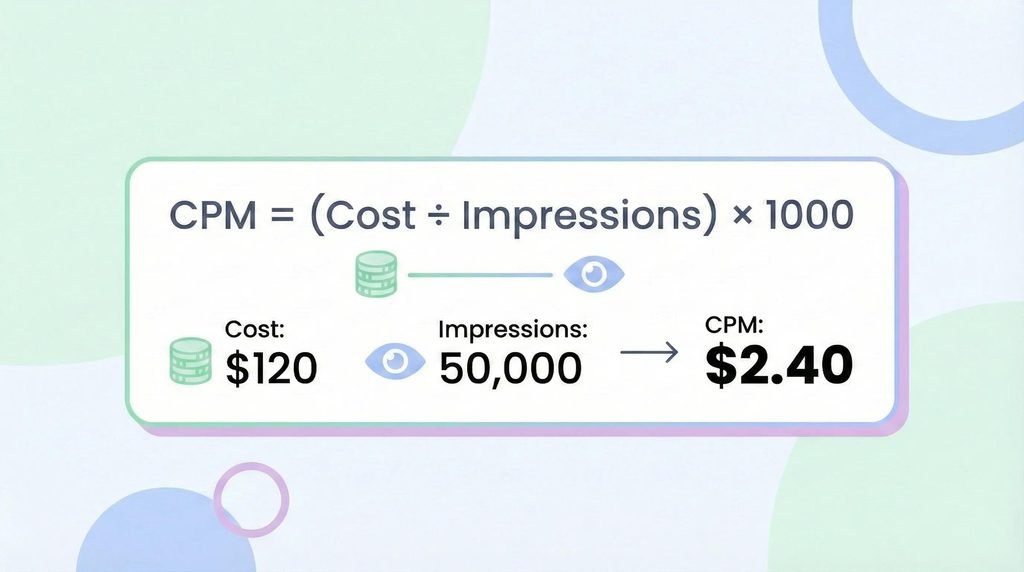
The CPM formula is simple:
CPM = (Total Ad Cost ÷ Total Impressions) × 1,000
You only need two numbers:
- Total Ad Cost: The amount you spent on your ad campaign.
- Total Impressions: The number of times your ad was shown.
For example:
Suppose you spend $50 and receive 10,000 impressions.
CPM = ($50 ÷ 10,000) × 1,000
CPM = 0.005 × 1,000
CPM = $5
Your CPM is $5, which means you paid $5 for every 1,000 impressions.
4. How to Calculate CPM
Follow these three simple steps to calculate CPM.
Step 1: Find your total ad cost
Check your advertising dashboard to see how much you spent on the campaign.
For example: $100.
Step 2: Find your total impressions
Check how many times your ad was shown.
For example: 25,000 impressions.
Step 3: Apply the CPM formula
CPM = ($100 ÷ 25,000) × 1,000
CPM = $4
Your campaign has a CPM of $4.
Calculate Your CPM Online
You do not need to work out the formula manually every time. Use our free CPM Calculator to calculate CPM in seconds.
Enter your total advertising cost and total impressions to get your result.
Try the Free CPM Calculator to check your campaign costs and plan your next advertising budget.
5. CPM Calculation Examples
Let us look at a few examples to make CPM easier to understand.
| Total Ad Cost | Total Impressions | CPM |
|---|---|---|
| $20 | 5,000 | $4.00 |
| $50 | 10,000 | $5.00 |
| $100 | 25,000 | $4.00 |
| $200 | 50,000 | $4.00 |
| $300 | 100,000 | $3.00 |
These examples show how CPM changes based on the money spent and the number of impressions received.
Example 1: Small Advertising Budget
You spend $30 on an ad and receive 10,000 impressions.
CPM = ($30 ÷ 10,000) × 1,000
Your CPM is $3.
Example 2: A Higher Advertising Cost
You spend $120 and receive 20,000 impressions.
CPM = ($120 ÷ 20,000) × 1,000
Your CPM is $6.
In this example, you pay twice as much per 1,000 impressions as in the first example.
Example 3: Finding the Cost of a Campaign
Suppose you want to reach 50,000 impressions and your expected CPM is $4.
Estimated Ad Cost = (50,000 ÷ 1,000) × $4
Your estimated ad cost is $200.
Remember that this is an estimate. Your actual cost may change based on audience, competition, and ad performance.
6. What Is a Good CPM?
There is no single CPM that is best for every advertiser.
A good CPM depends on your advertising platform, target audience, country, industry, campaign goal, and ad format.
For example, a campaign targeting a broad audience may have a lower CPM than a campaign targeting a small group of people who are more likely to buy an expensive product.
Here are a few things to check when judging your CPM:
- Compare campaigns on the same advertising platform.
- Look at results from similar audiences and locations.
- Compare your current CPM with your previous campaigns.
- Check whether your ads are reaching the right people.
- Consider clicks, leads, and sales, not just impressions.
Tip: A low CPM can help you reach more people for less money, but a higher CPM may still be worthwhile if it brings better customers or more sales.
7. Factors That Affect CPM
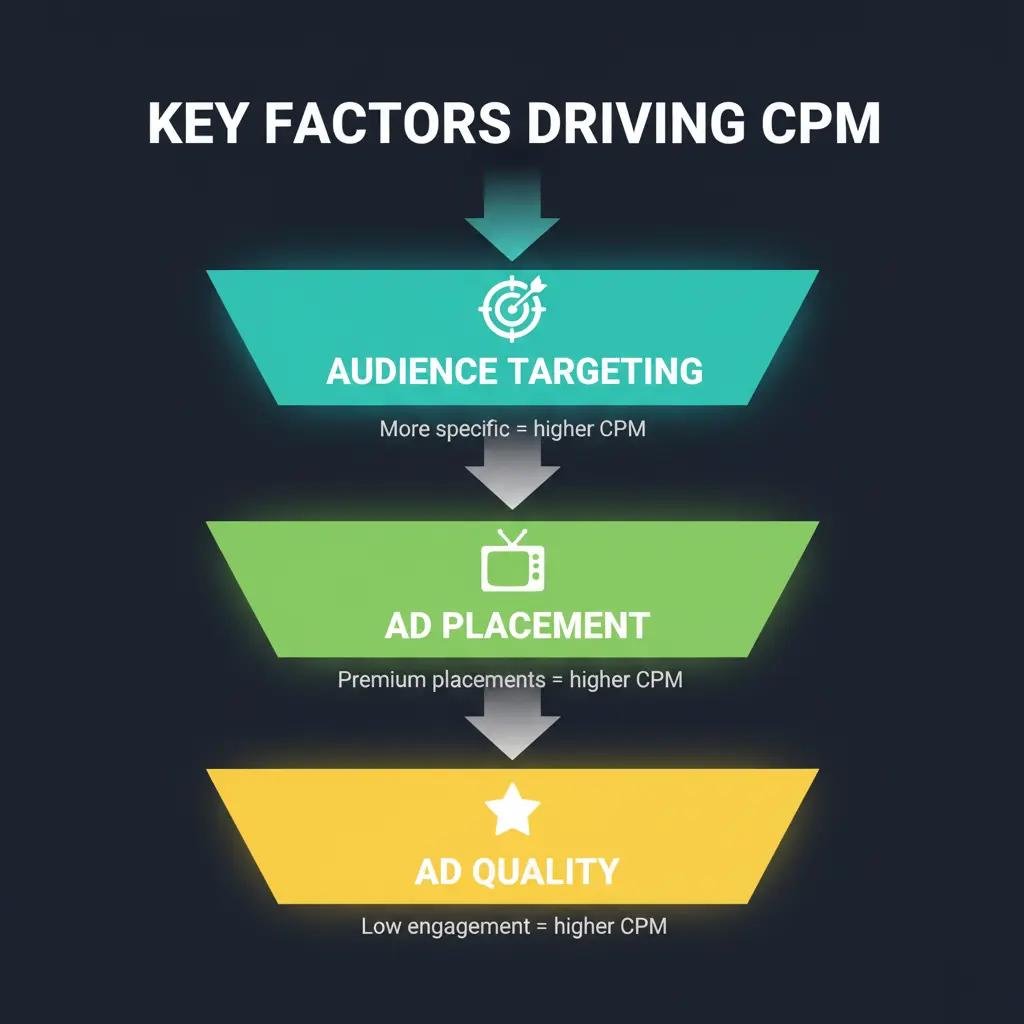
Several factors can change how much you pay for 1,000 impressions.
Target Audience
Some audiences are more competitive than others. If many advertisers want to reach the same people, the cost of showing ads to them may increase.
Advertising Platform
Different platforms have different users, ad systems, and levels of competition. Your CPM may vary between social media, video, and display advertising.
Country and Location
Advertising costs can differ by country, city, and region. The demand for a particular audience can affect how much advertisers pay.
Time of Year
During busy shopping periods, holidays, or major sales events, more businesses may compete for ad space. This can increase CPM.
Ad Placement and Format
Video ads, image ads, stories, and other placements may have different costs. The price also depends on the platform and the audience you choose.
Campaign Goal
Your campaign objective and bidding settings can affect delivery and cost. A campaign designed to reach people may perform differently from one designed to drive sales.
Audience Size and Competition
A very narrow audience can sometimes cost more to reach because fewer people are available and more advertisers may compete for them.
Understanding these factors helps you make better decisions when planning an advertising campaign.
8. CPM vs. CPC vs. CTR
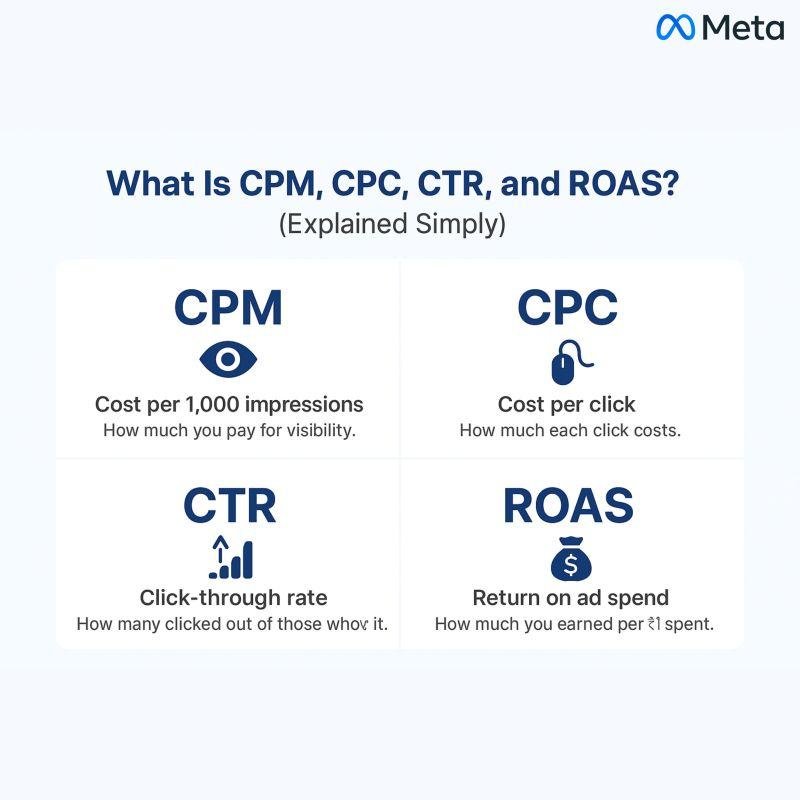
CPM, CPC, and CTR are three important advertising terms. They measure different things.
| Metric | Meaning | What It Tells You |
|---|---|---|
| CPM | Cost per 1,000 impressions | How much you pay for ad views |
| CPC | Cost per click | How much you pay for each click |
| CTR | Click-through rate | The percentage of impressions that lead to clicks |
What Is CPC?
CPC stands for Cost Per Click. It tells you how much you pay for each click on your ad.
For example, if you spend $50 and receive 100 clicks, your average CPC is $0.50.
CPC = Total Ad Cost ÷ Total Clicks
What Is CTR?
CTR stands for Click-Through Rate. It shows the percentage of impressions that resulted in clicks.
For example, if your ad receives 10,000 impressions and 200 clicks:
CTR = (200 ÷ 10,000) × 100
Your CTR is 2%.
Which Metric Should You Use?
Use CPM when you want to understand the cost of showing ads to people.
Use CPC when you want to measure the cost of getting clicks.
Use CTR when you want to see how often people click after seeing your ad.
These metrics work best when you consider them together.
9. How to Improve Your CPM
If your CPM is higher than expected, you can test a few changes to improve your campaign.
1. Review Your Target Audience
Make sure you are reaching the people who are most likely to care about your offer. Test different audience groups to see which one gives you better results.
2. Test Different Ad Formats
Try different images, videos, or placements if your platform supports them. Compare their costs and results before making a decision.
3. Improve Your Ad Content
Use clear images, simple messages, and a strong reason for people to pay attention. Relevant ads may help improve overall campaign performance.
4. Check Your Campaign Settings
Review your location, audience, placements, budget, and bidding settings. Small changes may affect delivery and cost.
5. Compare Results Over Time
Do not judge a campaign from one short period alone. Compare similar campaigns over a reasonable period and look for patterns.
6. Focus on Business Results
A low CPM is not the only goal. Check whether your campaign brings useful website visits, leads, or sales.
Remember: There is no guaranteed way to lower CPM. Test one change at a time and keep the changes that improve your results.
10. When Should You Use CPM Advertising?
CPM advertising can be useful when your main goal is to show your message to a large audience.
Common uses include:
- Brand awareness: Help more people discover your business.
- Product launches: Show a new product to a target audience.
- Website promotion: Increase the number of times your ads appear to potential visitors.
- Video advertising: Measure the cost of showing video ads.
- Campaign comparisons: Compare impression costs across similar campaigns.
CPM may not tell the whole story when your main goal is sales or website clicks. In those cases, also check metrics such as CPC, conversions, and return on ad spend.
11. Frequently Asked Questions About CPM
What is CPM in simple words?
CPM is the amount you pay for every 1,000 times your ad is shown. It helps advertisers understand the cost of reaching an audience.
How do I calculate CPM?
Divide your total ad cost by your total impressions, then multiply the result by 1,000.
Formula: CPM = (Total Ad Cost ÷ Total Impressions) × 1,000.
What is a $5 CPM?
A $5 CPM means you pay $5 for every 1,000 impressions. If your rate stays the same, 10,000 impressions would cost $50.
Is a lower CPM always better?
No. A lower CPM can help you reach more people for less money, but those people may not be the right audience. You should also check clicks, leads, and sales.
Does CPM mean people clicked my ad?
No. CPM measures impressions, not clicks. An impression means your ad was shown, while a click means someone clicked on it.
What is the difference between CPM and CPC?
CPM measures the cost of 1,000 impressions. CPC measures the cost of one click.
How much does 100,000 impressions cost?
The cost depends on your CPM. At a $4 CPM, 100,000 impressions would cost:
(100,000 ÷ 1,000) × $4 = $400.
Can I calculate CPM for free?
Yes. You can use our free CPM Calculator to work out CPM from your ad cost and impressions without doing the calculation manually.
Final Thoughts
CPM is a simple but useful metric for understanding the cost of online advertising. It tells you how much you pay for every 1,000 impressions and helps you compare the cost of similar campaigns.
To get the most from your advertising budget, look beyond CPM alone. Review your audience, ad content, clicks, leads, and sales to understand whether your campaigns are working well.
Ready to calculate your own numbers?
Use our free CPM Calculator to calculate your CPM, estimate campaign costs, and plan your advertising budget with confidence.